.webp?width=158&height=85&name=New-logo-Ourgreen%20(1).webp)

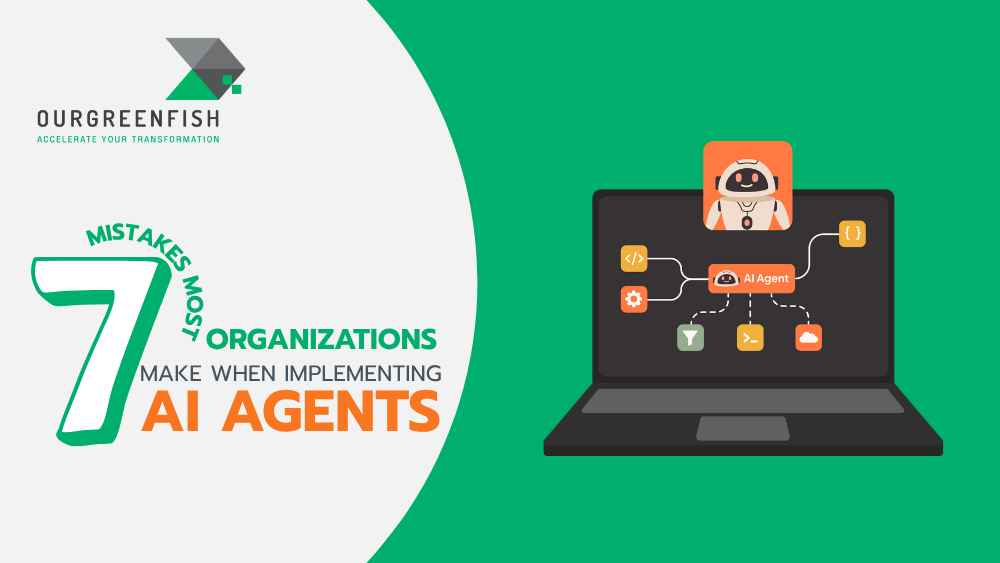
In 2025–2026, the term "AI Agents" is no longer just a buzzword; it represents a full transition into the digital workforce era. Industry reports show that global enterprises have funneled up to $37 billion into Generative AI. However, the shocking reality is that 95% of these projects fail to generate tangible profits.
Why is this the case? The answer isn't that the technology isn't smart enough, but rather that the implementation methods are riddled with pitfalls. As a business owner, if you don't want to be part of that 95%, here are the 7 mistakes you must know and how the top 6% of global "AI High Performers" navigate them.

1. Over-automation: Letting AI Work 100% Unsupervised
The most common mistake is viewing AI agents as "perfect replacements for human employees," leaving them to make critical decisions entirely on their own.
Costly Lessons: Take the case of Air Canada's chatbot providing inaccurate refund policy info to a customer, or New York City's MyCity chatbot advising business owners to break labor laws. The results? Massive legal liabilities and severe brand damage.
The Solution: Treat AI like an "enthusiastic new hire who needs a mentor." Adopt a Human-in-the-loop approach, especially for high-precision tasks. A human must always review and grant final approval for critical steps.

2. Unrealistic Expectations
Many business owners fall into the trap of "Agent Washing"—believing marketing hype that AI agents can solve every problem out of the box as a plug-and-play solution.
- The Reality: In 2026, AI agents still require domain-specific fine-tuning. Gartner predicts that over 40% of agentic AI projects will be canceled because the results fail to justify the investment.
- The Solution: Start with low-risk, repetitive, low-precision tasks like summarizing data or drafting emails. Understand that AI is a force multiplier, not a magic wand.
3. Launching Without a Clear Strategy or Roadmap
Many organizations deploy AI simply due to FOMO (Fear of Missing Out), lacking a structured roadmap. The pitfall here is building a "jack of all trades, master of none" AI, which drains both time and money.
- The Solution: Implement a 4-stage roadmap (Assessment, Implementation, Integration, Measurement). Start by asking, "Which problem is most valuable to solve?" instead of "What can we use AI for?"

The 4-Stage AI Agent Roadmap
- Assessment: This stage lays the foundation by selecting high-frequency, low-risk (low-precision) tasks where a 90% accuracy rate is acceptable and early errors won't paralyze the business. Crucially, conduct a Data Audit to ensure your internal data is clean, organized, and accessible to the AI via APIs. Define success metrics (KPIs) and baselines upfront.
- Implementation: Focus on the "Start Small, Scale Smart" principle by launching a single, well-defined pilot use case. Choose technology that matches your team's skillset (e.g., no-code tools for non-technical staff or custom builds for tech teams). Design "Human-in-the-loop" guardrails for critical checkpoints and rigorously test the system with historical data before going live.
- Integration: Seamlessly embed AI agents into your actual daily workflows. Focus on secure data access and design intuitive user interfaces (UI) so employees can collaborate with AI naturally. Pay close attention to role-based access controls (permissions) and audit trails for compliance and security.
- Measurement: Track performance against predefined KPIs, aiming for a Task Completion Rate (TCR) of over 85%. Measure the actual Return on Investment (ROI). Use real-world usage data to iterate and fine-tune the model, capturing insights for your expansion planning into other departments.

4. Data Unreadiness: Unprepared Data Equals Useless AI
An AI agent is only as good as the data it can access. Yet, over 63% of organizations lack the data management maturity required for AI.
- The Technical Issue: A common misstep known as "Dumb RAG" happens when companies dump massive amounts of unfiltered data into the system. As a result, the AI hallucinates, serving up conflicting or flat-out incorrect information because it gets confused by its own source material.
- The Solution: Allocate 50–70% of your AI budget to data cleaning and structuring. Establish a Single Source of Truth so your AI can pull references accurately.
5. Integration Failure with Legacy Systems
No matter how brilliant your AI is, if it can't interface with your legacy systems like Salesforce, ERPs, or accounting software, it turns into mere "Decoration AI"—fancy but useless.
- The Major Pitfall: Relying on "Brittle Connectors" (rigid integrations). If a core system undergoes even a minor update, it breaks the connection, causing the AI to halt entirely.
- The Solution: Focus on an API-first architecture and adopt event-driven systems to ensure the AI seamlessly blends into your team's live workflows.

6. Operating Without Clear KPIs
"If you can't measure it, you can't improve it." Organizations frequently fail by setting vague goals like "driving modernization."
The Solution: Establish concrete metrics, just as you would for a human employee:
- Task Completion Rate (TCR): What percentage of tasks does the AI resolve end-to-end without human intervention? (Target should be >85%).
- Response Time (RT): The speed of execution or reply (Target should be <3 seconds).
- Automation ROI: Calculated as: (Hours Saved × Employee Hourly Wage) − AI Operational Costs.
7. Overlooking Compliance and Privacy
In an era where AI must handle customer data, security is paramount. Projections show that 50% of future AI exploits will involve "Prompt Injection"—tricking the AI into leaking confidential data.
The Solution: Implement ironclad security guardrails (modeled after frameworks like HubSpot's):
- No Data Training: Ensure AI vendors do not use your proprietary data to train their public models.
- Zero Data Retention: Enforce immediate data deletion after processing is complete.
- Governance Framework: Set up strict, granular user permission levels to control who can access what data.
Success with AI Agents isn't defined by who deploys the smartest model; it is decided by who possesses the best data foundation and who can design the most seamless human-AI collaboration. By avoiding these 7 critical mistakes, you will transform AI from an expensive overhead into a powerhouse engine for sustainable competitive advantage in 2026.

References:
- Mindstream & Futurepedia. (2026). AI Agents Unleashed: Playbook for 2026 Success. Retrieved from https://offers.hubspot.com/view/ai-agents-unleashed-playbook
- Gartner. (2025). Gartner Predicts Over 40 Percent of Agentic AI Projects Will Be Canceled by End of 2027. Retrieved from https://www.gartner.com/en/newsroom/press-releases/2025-06-25-gartner-predicts-over-40-percent-of-agentic-ai-projects-will-be-canceled-by-end-of-2027
- McKinsey & Company. (2025). One year of agentic AI: Six lessons from the people doing the work. Retrieved from https://www.mckinsey.com/capabilities/quantumblack/our-insights/one-year-of-agentic-ai-six-lessons-from-the-people-doing-the-work
- HubSpot. (n.d.). HubSpot AI Transparency: The Architecture of Trust. Retrieved from https://trust.hubspot.com/ai/

Contact us
Tel : 024-609-599
E-mail : contact@ourgreen.co.th
Website : ourgreenfish.com







No Comments