.webp?width=158&height=85&name=New-logo-Ourgreen%20(1).webp)

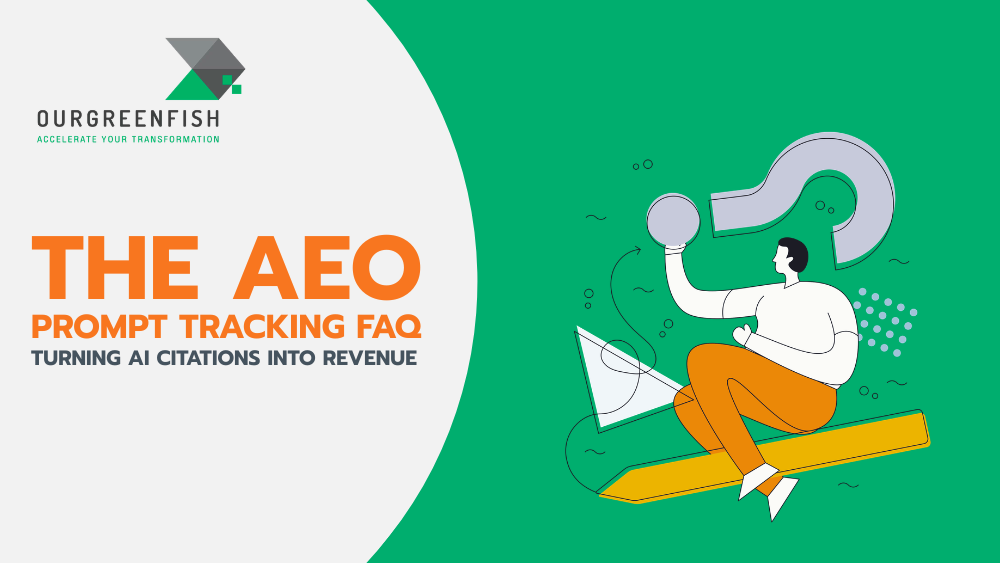
As a business owner, you may have noticed a shift in your recent marketing reports: customer behavior is evolving. Your target audience isn't just scrolling through Google's first page to click links one by one anymore. Instead, they are engaging in conversational searches—typing detailed, long-tail questions into AI systems like ChatGPT, Perplexity, and Gemini to get direct recommendations.
This shift raises critical questions: How do we know if our brand is being recommended by AI engines? How do we measure this visibility? And how do we convert those AI answers into actual revenue?
This FAQ breaks down the essential concepts to help you structure your tech stack and strategy in the AI Search era.
Direct Answer: An AEO Prompt Tracking FAQ provides answers to key questions about monitoring brand presence across Answer Engines. The core shift is moving away from keyword rank tracking (SEO) toward verifying whether your brand appears directly within AI-generated responses. Success relies on tracking 5 core metrics, maintaining quarterly prompt library updates, and connecting AI traffic data to your CRM to fuel pipeline growth.

5 Essential AEO Prompt Tracking FAQs
1. Deep Dive: How Does AEO Prompt Tracking Differ from SEO Rank Tracking?
This is the single most common question from business leaders. The two approaches differ across four primary dimensions:
- Data Source & Measurement: Traditional SEO rank tracking pulls data from Search Engine Result Pages (SERPs) to report numerical positions (e.g., ranking #3 for a keyword). AEO Prompt Tracking extracts data directly from AI outputs, delivering a presence-or-absence signal along with context on how your brand is cited (e.g., as a primary recommendation, supporting detail, or footnote reference).
- Stability: SEO rankings fluctuate with algorithm updates, but they are generally deterministic and stable day-to-day. Answer Engine responses are non-deterministic—the exact same prompt can yield different outputs and citations across different chat sessions, AI model versions, or even back-to-back queries.
- Attribution: Clicks from organic Google search pass clean referral URLs that are easy to track in web analytics. AI citations often show up as Direct Traffic or unattributed sessions because users frequently copy-paste links or open them directly in separate windows.
- Competitive Framing: SEO measures brand position on a linear, ranked list. AEO evaluates whether your brand enters the answer at all, measuring performance using Citation Share (the percentage of time your brand is cited relative to competitors for a given set of prompts).
Recommendation: Don't choose one over the other. High-performing marketing teams run SEO Rank Tracking and AEO Prompt Tracking in parallel, mapping shared Topic Clusters to compare visibility across traditional and generative search simultaneously.

2. What Are the 5 Key AEO Metrics Business Leaders Should Review Monthly?
To avoid drowning in raw data, business owners should review these 5 core metrics at the end of every month:
- Citation Share: The percentage of times your brand is cited in AI responses relative to competitors across a defined prompt library. This is your top-of-funnel share-of-voice metric.
- Coverage by Engine: Tracking visibility independently across ChatGPT, Perplexity, Gemini, Microsoft Copilot, and Google AI Overviews. Aggregated averages can hide severe blind spots on specific platforms.
- Citation Trend (MoM): Month-over-month growth curves showing whether your citation footprint is expanding or declining, proving content ROI or alerting you to competitive encroachment.
- Source Gaps: The volume of high-intent prompts where your brand should be cited but currently isn't. This metric helps content teams prioritize which pages to update or create first.
- AI Referral Traffic: Total web sessions originating from Answer Engines. An upward trend validates that AI visibility is successfully driving actual site visits.
3. How Often Should You Review and Update Your Prompt Library?
A prompt library isn't a "set-it-and-forget-it" asset. Organizations should establish a structured governance cadence:
- Monthly: Audit emerging queries driven by new product launches, competitor moves, or industry trends. Add new prompts while keeping your core baseline intact to maintain trend accuracy.
- Quarterly: Perform a comprehensive audit of the entire prompt library. Prune obsolete prompts, integrate new campaign themes, and verify that mapped landing page URLs and CRM funnel tags are functioning without broken links.
- Event-Driven: Trigger immediate updates whenever you launch a major product line, when key competitors rebrand, or following major AI foundation model updates.

4. Can You Connect AEO Data to Your Pipeline Without Buying New Tools?
Yes, you can—though it requires manual data stitching. Here is how to start:
- Segment AI Traffic in Analytics: Create custom traffic segments for Answer Engines (Perplexity is currently the most straightforward to track) and monitor Direct Traffic spikes alongside known citation wins.
- Map Prompts to CRM Landing Pages: Assign target landing page URLs to your core prompts. When visitors arrive on those pages from AI sources, configure your CRM to tag contact records with campaign/source properties.
- Report at the Cohort Level: Since individual AI click-tracking remains restricted by platform privacy, evaluate results by cohort (e.g., "Visitors entering through top-of-funnel AEO target pages generated X% pipeline growth this quarter").
While manual setups work for early experimentation, they become fragile and labor-intensive as prompt volumes scale. Businesses seeking efficiency often upgrade to dedicated platforms like HubSpot AEO, which automatically suggests CRM prompts, tracks engine citations, and unifies contact timelines and pipeline reporting within a single dashboard.

5. What 4 Automation Triggers Should Businesses Implement?
Once your stack is connected, automated triggers prevent your team from manually checking dashboards every day:
- Citation Loss Alerts: Instant notifications triggered when key prompts lose citation share across two consecutive monitoring runs.
- Competitor Entry Alerts: Alerts when new competitors begin appearing in AI responses for your core prompt clusters.
- Traffic Threshold Triggers: Automated workflows in your CRM/Analytics that fire when AI traffic to a target landing page crosses defined high or low thresholds.
- Quarterly QA Automation: Recurring system tasks that schedule prompt library cleanups, update trusted domain lists, and audit reporting accuracy.
HubSpot Advantage: Native AEO integration calculates citation share shifts and competitive position changes automatically—eliminating the need to build custom API scripts or maintain third-party workflow integrations.
Conclusion
Winning in the age of AI Search requires structured data management and clear execution. Business owners who master key AEO metrics, automate prompt monitoring, and tie citations directly into their CRM pipeline will be the first to transform AI visibility into sustainable revenue growth.
Looking to elevate your business's AEO strategy? Consult with Ourgreenfish today.
Reference: HubSpot. (2026). AEO prompt tracking for marketing teams. Retrieved from https://blog.hubspot.com/marketing/aeo-prompt-tracking
Read more articles : Why Businesses with Customer Data and CRM Gain an Advantage in the AEO and AI Era (ทำไม AEO ในยุค AI ธุรกิจที่มี Customer Data และ CRM จะได้เปรียบกว่า)

Contact us
Tel : 024-609-599
E-mail : contact@ourgreen.co.th
Website : ourgreenfish.com





No Comments