

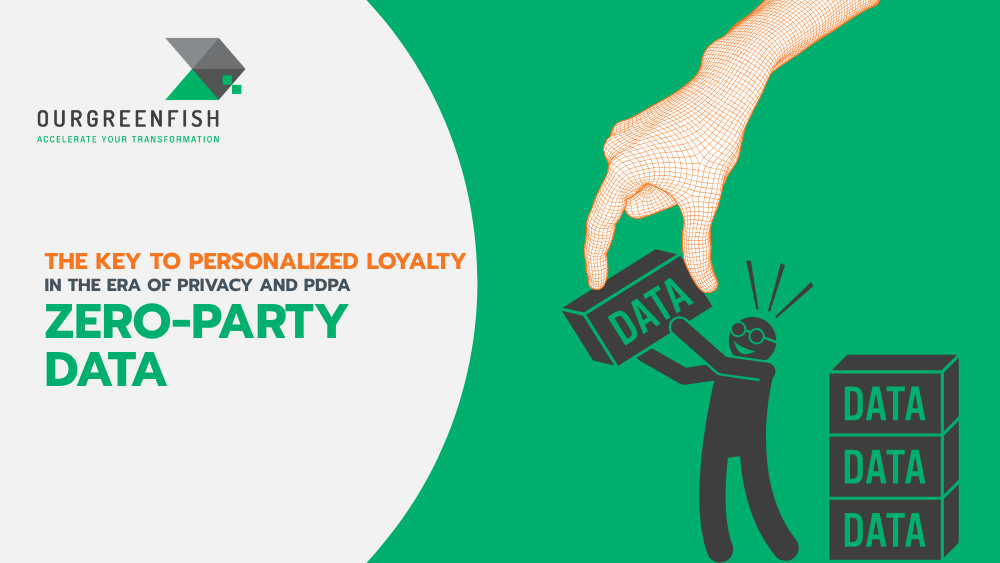
In an era where consumers demand hyper-personalized experiences, privacy regulations like PDPA and increasingly strict operating system controls make silently tracking behavioral data more challenging than ever. This is the exact paradox business owners face today.
Data from Salesforce, published by Trifft Loyalty, clearly reflects this dilemma: 73% of customers feel companies treat them more as individuals, but at the same time, 71% are increasingly cautious with their personal data, and 61% view corporate trustworthiness as paramount due to advances in AI technology.
The question is: How can businesses understand customer needs without making them feel their privacy is being invaded? The answer lies in shifting away from data noise toward collecting Zero-Party Data.
What is Zero-Party Data, and How Does It Differ from First-Party Data?
- First-Party Data (Inferred Behavioral Data): Information brands observe and collect across various touchpoints—such as purchase history, items added to a cart, time spent scrolling on a web page, or email click-through history. This data tells us what customers did, but not the actual reason why.
- Zero-Party Data (Willingly Shared Data): Data that customers intentionally and transparently hand over to brands—such as personal interests, tastes, purchase goals, life context, or preferences on how they want the brand to interact with them. This data explicitly reveals what customers want and why they want it.
|
Aspect |
First-Party Data |
Zero-Party Data |
|
Data Source |
Implicitly collected by brand through user behavior |
Explicitly and intentionally provided by the customer |
|
Accuracy |
Requires interpretation, inference, or analysis |
100% accurate because it comes directly from the customer |
|
Privacy Perception |
Can make customers feel tracked or surveilled |
Feels safe and empowering as customers choose what to disclose |
Why Willingly Shared Data is Critical for Personalization
Relying solely on First-Party Data often leads to flawed assumptions. For instance, if a customer buys a maternity dress on your website, your system might infer she should receive baby product promotions—when in reality, she was simply buying a birthday gift for a friend. Blasting her with infant product deals afterward becomes an annoyance rather than a personalized gesture.
With Zero-Party Data, you gain accurate insights without the guesswork. When customers tell you directly what they like or dislike, your AI and personalization engine operate with precision, significantly boosting conversion rates for discounts or Next Best Offers.

The Value Exchange Principle: Offer True Value to Earn Data
No customer gives away personal data for nothing. The cornerstone of acquiring Zero-Party Data is an equitable Value Exchange.
If a brand wants deeper insights, it must offer immediate, tangible value in return, such as:
- Tailored Recommendations: Saving customers time when searching for products.
- Personalized Benefits: Early access privileges or targeted discounts in preferred categories.
- Frictionless Experiences: Eliminating the need to re-enter information during future purchases.

Practical Examples of Zero-Party Data Collection via Value Exchange
Collecting Zero-Party Data doesn't require tedious long-form surveys; it can be seamlessly woven into the customer journey:
- Beauty Quiz (Beauty & Skincare): A brief quiz where customers select their skin type, main skin concerns, and budget to receive a personalized skincare routine along with an exclusive bundle discount.
- Style Preferences (Fashion): Allowing shoppers to select preferred styles, sizes, and color palettes to unlock early access to upcoming collections.
- Dietary Preferences (Food & Dining): Membership profiles where guests specify dietary restrictions (e.g., vegan, dairy-free, low spice) in exchange for customized menu coupons matching their health profiles.

Navigating Privacy & PDPA: Collect Transparently, Not Excessively
Under PDPA and rising privacy concerns, data collection in 2026 is no longer about hoarding as much information as possible. The mantra is now: "Collect only what is necessary and use it transparently."
With 61% of consumers stating that AI advances make company trustworthiness paramount, brands must be explicitly clear about how customer data is used and secured. Most importantly, customers need to experience immediate proof that sharing their data directly improves their experience.
Building sustainable Personalized Loyalty isn't measured solely by algorithm intelligence, but by genuine communication. Shifting focus to Zero-Party Data empowers your business with accurate insights, fully compliant consent, and—most importantly—unshakable customer trust, the single most valuable currency in the digital age.

Reference: Trifft Loyalty. (2026). Loyalty programs in 2026: AI, data and personalization trends. Retrieved from https://www.trifftloyalty.com/blog/loyalty-programs-in-2026-ai-data-and-personalization-trends
Read more articles: Deep Dive into Strategies to Reclaim Profits from Marketplaces Using Loyalty Systems (เจาะลึกกลยุทธ์ทวงคืนกำไรจาก MARKETPLACE ด้วยระบบ LOYALTY)

Contact us
Tel : 024-609-599
E-mail : contact@ourgreen.co.th
Website : ourgreenfish.com







No Comments