
.webp?width=158&height=85&name=New-logo-Ourgreen%20(1).webp)

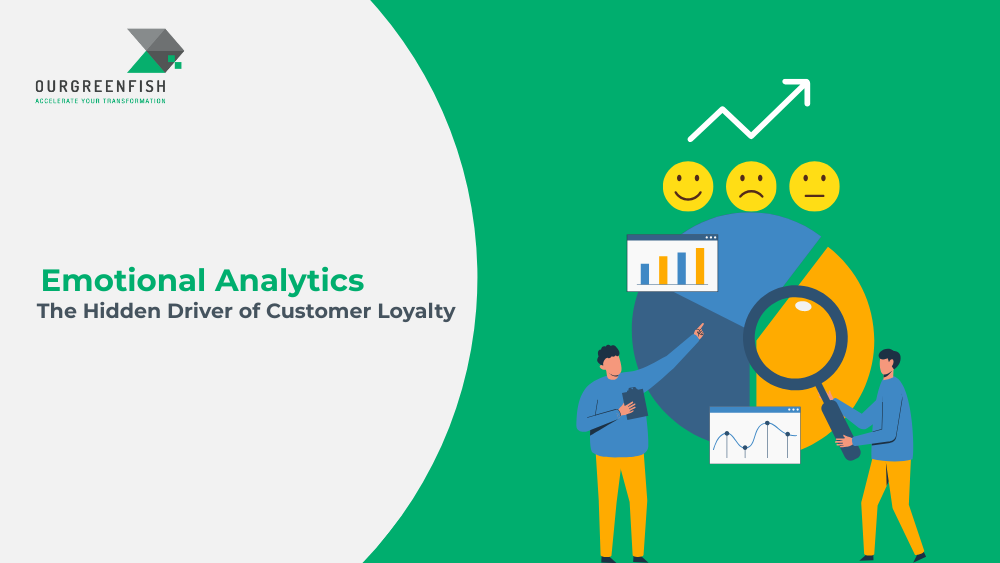
Most business owners are familiar with traditional metrics such as sales figures or general satisfaction indicators like NPS and CSAT. However, HubSpot’s recent insights show that marketing has fully shifted away from B2B (Business-to-Business) and B2C (Business-to-Consumer) toward the new era of B2H — Business-to-Human.
At the heart of B2H lies the understanding that humans — not segments — make decisions, and those decisions are powered by emotion. Successful businesses today are not just selling products or services; they are selling feelings that customers want to connect with. People remember how your brand made them feel far longer than they remember the messages you delivered.
Why Measuring “Behavior” Alone Is No Longer Enough
Emotional Analytics (EA) blends psychology with advanced technology to measure, decode, and improve human emotions using real-time data. This field emerged to overcome the limitations of traditional business KPIs.
- Numbers Hide the Full Story
Traditional satisfaction metrics capture what customers think (opinions), not how they truly feel. Two customers may give the same “satisfied” rating for entirely different emotional reasons: one may feel mildly pleased, while another feels relieved that the experience wasn’t worse.
EA uncovers these hidden emotional drivers that influence decision-making.
- Emotional ROI: The Profitability of Human Connection
Emotionally connected customers spend twice as much per transaction and are 2–3 times more likely to recommend a brand. They are also more forgiving when problems occur — making emotional loyalty one of the most profitable strategic assets a business can build.
From Sentiment Analysis to Emotional Patterns: Understanding the Difference
For business owners considering AI adoption, it’s important to distinguish between basic tools and in-depth Emotional Analytics.
Sentiment Analysis (SA): Detecting Basic Positive/Negative Tones
SA classifies feedback as positive, negative, or neutral, which is valuable for monitoring brand reputation.
But this alone is insufficient — a “negative” sentiment doesn’t reveal whether a customer is angry, disappointed, or anxious.
Emotional Detection Analysis (EDA): Identifying Specific Emotions
EA moves beyond basic classification through Emotion Detection Analysis, identifying psychological emotions such as Joy, Anger, Sadness, Fear, and Anxiety — often across 6–8 emotional dimensions.
Why this matters:
- Anger requires urgent resolution.
- Sadness requires empathy and reassurance.
Handling each emotion correctly leads to better outcomes and reduces escalations.
Aspect-Based Sentiment Analysis (ABA)
ABA allows AI to evaluate sentiment across specific aspects of a customer’s comment.
Example: “I love the product quality, but the delivery was slow and frustrating.”
AI categorizes:
- Product quality → Positive
- Delivery service → Negative
This helps brands pinpoint emotional pain points affecting specific parts of the customer journey.
 AI’s Role in Detecting Hidden Intent and Emotional Needs
Emotional Analytics relies heavily on AI and Natural Language Processing (NLP) to process massive amounts of unstructured data from reviews, emails, and chats. This allows businesses to move from reactive to predictive customer management.

Prioritizing Emotional Urgency in Customer Service
AI does more than respond — it triages emotions.
If AI detects anger or high frustration about a technical issue, it can immediately escalate the case to a technical specialist. Fast, precise responses significantly reduce the risk of churn.
Emotional AI in Sales and Relationship Building
In high-value B2B sales, AI can analyze tone, facial cues, or word choice to detect hesitation or anxiety.
Sales teams can adjust their approach in real time, building trust and boosting conversion rates.
Future Metrics : Emotion-to-Action Rate (E-A Rate)
Once emotions are accurately measured, the next step is linking them to tangible business outcomes.
This leads to a new generation of KPIs driven by emotional insight.
- Predicting Churn Through Frustration Scores
EA identifies “Silent Sufferers” — customers who are highly dissatisfied but do not complain. They quietly abandon the journey long before conversion.
Frustration scores transform subtle emotional signals into structured data that can be used in churn prediction models.
Executives gain clearer visibility into the true financial impact of service failures.
- Emotion-to-Action Rate (E-A Rate) and Emotional Loyalty Score (ELS)
E-A Rate measures whether emotional states (excitement, frustration, anxiety) lead to desired or undesired business actions.
Examples:
- Boosting Conversion
When customers show high excitement, time-sensitive offers can increase purchase velocity. - Reducing Bounce Rates
When frustration is detected, automated personalized assistance can prevent customer drop-off.
ELS (Emotional Loyalty Score) measures long-term emotional bond strength — a powerful predictor of Customer Lifetime Value.
Managing Trust in the Age of Emotional Analytics
As EA processes sensitive emotional data, ethics and privacy are critical.
Businesses must:
- Inform customers when emotional AI is used
- Explain how emotional data is analyzed
- Clearly state usage in privacy policies
Transparency builds trust — the foundation of lasting loyalty in the B2H era.
References :
- HubSpot. (2025). Forget B2B or B2C: It's Time for B2H. Retrieved from https://blog.hubspot.com/marketing/forget-b2b-or-b2c-its-time-for-b2h
- Content Shifu. (2024). Sentiment Analysis เมื่อความรู้สึกของลูกค้าสามารถวิเคราะห์ได้ผ่านข้อความ. Retrieved from https://contentshifu.com/blog/what-is-sentiment-analysis/
- American Bar Association. (2024). The Price of Emotion: Privacy, Manipulation, and Bias in Emotional AI. Retrieved from https://www.americanbar.org/groups/business_law/resources/business-law-today/2024-september/price-emotion-privacy-manipulation-bias-emotional-ai/
- Phable. (n.d.). Emotional Analytics: Unlocking the Power of Customer Sentiment. Retrieved from https://www.phable.io/phable-labs/emotional-analytics-customer-sentiment
- Contentsquare. (n.d.). Churn Prediction and Prevention. Retrieved from https://contentsquare.com/guides/data-connect/churn-prediction-prevention/
Read more articles : 8 Key Principles of Digital Marketing and How to Use Them (8 แนวทางหลักใน การทำ Digital Marketing พร้อมวิธีการใช้งาน)

Contact us
Tel : +66 2-0268918
E-mail : contact@ourgreen.co.th
Website : ourgreenfish.com










No Comments