
.webp?width=158&height=85&name=New-logo-Ourgreen%20(1).webp)

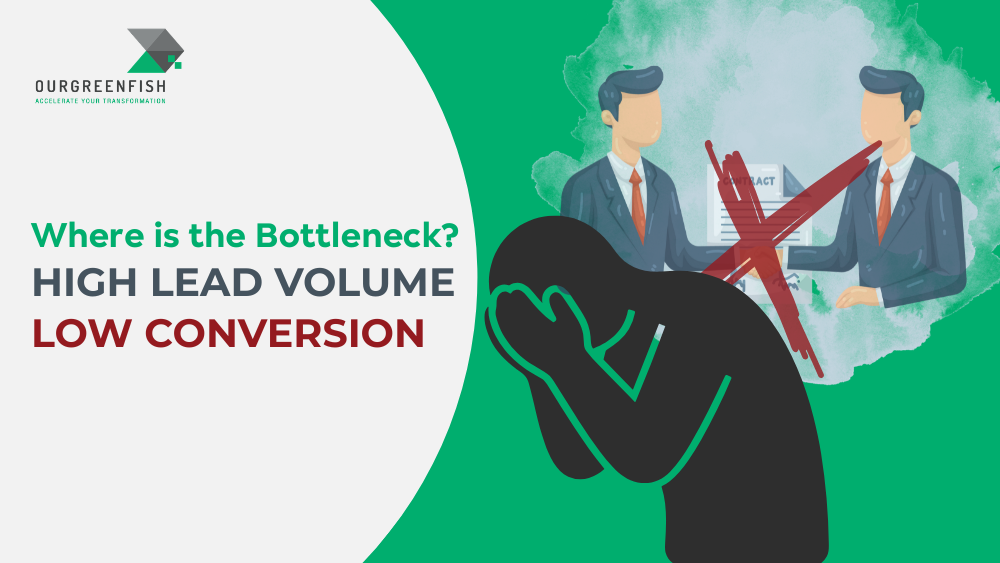
Many businesses enjoy a high volume of leads from various marketing channels, yet find that actual sales or conversion rates remain disappointingly low. Why does this happen? Research indicates that without an efficient Lead Management System, even a high influx of prospects can result in "leaky" sales funnels. This is often due to delayed responses, inconsistent follow-ups, or a lack of alignment between marketing and sales teams. In short, the issue isn't the quantity of leads, but rather how those leads are managed and nurtured toward a closing.
High Lead Volume, No Sales – What’s the Catch?
Having a large number of leads does not guarantee success. Without proper management, sales teams often fail to track every lead or lack the speed required to engage new prospects. Furthermore, without clear criteria for what constitutes a "sales-ready" lead, valuable opportunities slip through the cracks. Even as the list of prospects grows, revenue stagnates because most leads never transition into actual customers.
Instead of focusing solely on increasing lead volume, executives should evaluate the quality of existing leads and the efficiency of the systems in place. Focusing on the "right" lead is far more productive than managing a massive list of uninterested contacts.

Lead Quality vs. Lead Quantity: The 2026 Paradigm
In 2026, the focus has shifted decisively toward quality over quantity. Modern businesses utilize tools that measure both the volume and the caliber of incoming leads. Advanced Lead Management dashboards now provide visibility into:
- Lead Volume: Total entries into the system.
- Lead Quality: How well they match the Ideal Customer Profile (ICP).
- Speed-to-Lead: How quickly the team responds.
- Conversion Rates: The transition efficiency at every stage of the funnel.
A massive pool of leads is meaningless if they aren't ready to buy. Conversely, a smaller pool of high-intent leads yields better ROI. When sales teams waste time filtering through unqualified contacts, they have less time for high-value prospects. Ultimately, lead quality is the decisive factor for success.
The HubSpot Framework: One key concept is the Lead Lifecycle, which categorizes prospects as:
- MQL (Marketing Qualified Lead): Vetted by marketing.
- SQL (Sales Qualified Lead): Accepted by sales for direct follow-up.
- Opportunity: A lead that has evolved into a concrete deal.
Tracking the transition rates between these stages allows management to identify bottlenecks and ensure lead quality remains high.

Leveraging Customer Data to Assess Sales Readiness
Determining if a lead is "ready" requires comprehensive data. Today, businesses collect data from registration forms, ads, chatbots, and events. A robust Lead Management system then performs Data Enrichment, pulling in firmographic data (company size, industry) and intent signals (behavioral data).
By using Lead Scoring models, the system evaluates readiness. Leads that hit a specific threshold are automatically routed to the correct salesperson based on geography or product type. Simultaneously, Lead Nurturing Workflows (automated emails or messages) ensure no prospect is forgotten. This process works best when integrated with a Smart CRM (like HubSpot), which unifies data and automation in a single source of truth.
AI-Powered Filtering and Prioritization
Artificial Intelligence (AI) has revolutionized lead management. For organizations handling massive volumes, AI analyzes behavioral history to predict high-intent leads. It then creates a Prioritized Queue, so salespeople don't have to guess who to call first.
AI also reduces manual labor by:
- Drafting personalized follow-up emails.
- Summarizing recent interactions.
- Alerting teams when a lead shows "hot" signals (e.g., revisiting a pricing page).
HubSpot’s Predictive Lead Scoring is a prime example, using AI to rank leads based on email engagement, website visits, and demographics. This allows teams to focus their energy where it matters most.

Measuring Success: KPIs and ROI
To ensure investments in lead management pay off, businesses must track specific performance indicators. Key metrics include the MQL to SQL Conversion Rate, which shows how well marketing and sales are aligned, and the Lead-to-Opportunity Rate, which reflects how many leads turn into real sales deals. Additionally, monitoring the Revenue by Lead Source helps identify which marketing channels are actually driving the most value.
| KPI | What it Measures |
| MQL to SQL Conversion | The alignment between marketing quality and sales needs. |
| Speed-to-Lead | The time elapsed between lead submission and first contact. |
| Lead Quality Score | The average "fit" and "intent" of incoming prospects. |
| Lead-to-Opportunity Rate | How many leads turn into real sales deals. |
| Revenue by Lead Source | Which channels produce the highest monetary value. |
It’s the System, Not the Numbers
Ultimately, the "high lead, low sales" problem is a systemic failure, not a marketing one. A strong Lead Management System—like HubSpot Smart CRM—integrates CRM, marketing automation, and AI to ensure every lead is captured, scored, routed, and nurtured.

If your business is struggling to convert, don't just buy more leads. Re-evaluate your strategy and tools. By prioritizing quality and leveraging automation, you can ensure your sales team focuses on the right prospects at the right time, turning opportunities into sustainable growth.
Reference: Michael Welch. (2026). Best lead management systems for growing businesses in 2026. Retrieved from https://blog.hubspot.com/sales/lead-management-system
Read more articles: How to create a good lead scoring matrix for your business (วิธีสร้างเมทริกซ์ของ LEAD SCORING ที่ดีสำหรับธุรกิจของคุณ)

Contact us
Tel : 024-609-599
E-mail : contact@ourgreen.co.th
Website : ourgreenfish.com









No Comments