
.webp?width=158&height=85&name=New-logo-Ourgreen%20(1).webp)

Over the past few years, consumer search behavior has changed significantly. Instead of starting with Google Search, many people now begin by asking questions directly to AI—whether through ChatGPT, Google SGE, or other AI assistants.
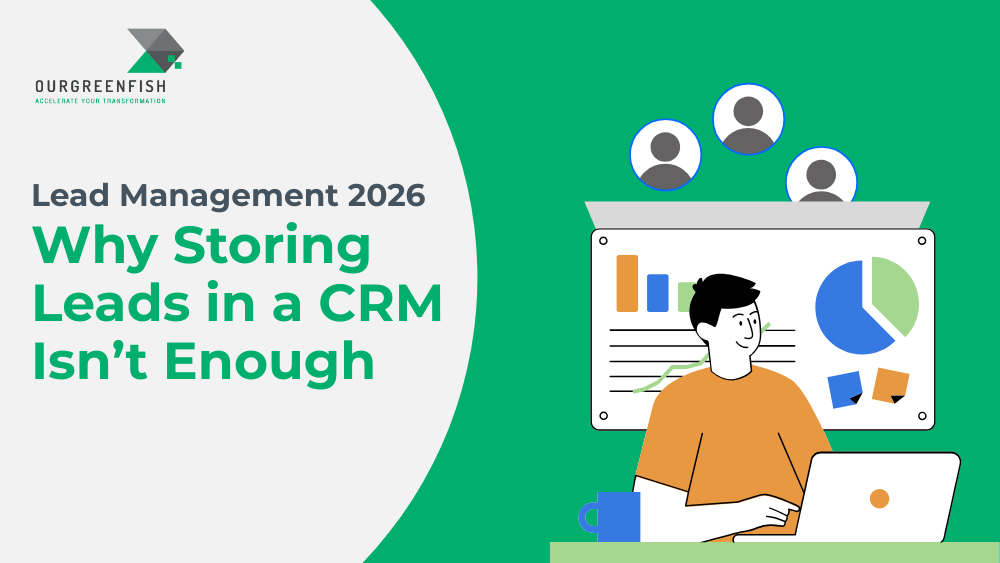
But as businesses scale into 2026, many leaders are facing a different reality: Even with a CRM in place, business outcomes aren’t improving as expected.
- Leads are increasing, but sales remain stagnant
- Sales teams are working harder, yet struggling to close deals
- Customer data is available, but decisions remain imprecise
At this point, the strategic question is no longer “Do we have a CRM?” but rather: “Is our CRM helping us manage leads to actually drive revenue?”

A Lead Is More Than Just Data—It’s a Revenue Opportunity
In the past, Lead Management was commonly defined as the process of storing and tracking prospective customers. But as HubSpot emphasizes, that’s no longer sufficient. A lead is no longer just a “record in your CRM”—it’s a potential business opportunity that must be actively managed.
Lead Management in 2026 means designing a process to guide leads from the moment they discover your brand, through their decision-making phase, and into a long-term relationship.
In this context, Lead Management becomes part of a business’s revenue strategy, not just a function of the sales team.
And the follow-up question for business owners is: Does your current CRM truly support this broader view of Lead Management?
The Real Problem Isn’t the CRM—It’s How It's Used in Silos
When business outcomes disappoint, many teams are quick to blame their CRM. But according to HubSpot, the issue often isn’t the software—it’s how organizations use it.
Most companies use CRM tools in departmental silos:
- Marketing uses CRM to capture leads from campaigns
- Sales uses CRM to track deals and follow-ups
- Service teams use a different system entirely
When customer data is siloed, context gets lost between handoffs:
- Sales doesn’t understand what the customer engaged with before
- Service teams don’t know what expectations were set during the sales process
In the end, leads are treated like disconnected “tickets” rather than ongoing relationships. And businesses miss out on revenue opportunities—often without realizing it.

Customer Platform: Evolving CRM into Business Infrastructure
Once we accept that leads must be managed across the entire journey, the question shifts from “How do we store data?” to “How do we give every team the same customer picture?” This is where the concept of a Customer Platform becomes critical.
A Customer Platform doesn’t replace a CRM—it elevates it. It transforms the CRM from a simple data repository into a centralized customer infrastructure for the entire organization.
According to HubSpot, an effective Lead Management system must connect data from marketing, sales, and service to create a Single Customer View.
When everyone uses the same data:
- Decisions aren’t based on personal opinion or partial information
- Teams align around real-time, contextual insights
- The CRM shifts from being a “system of record” to a driver of business growth

Lead Management Must Span the Entire Customer Journey
Another common misconception is that a lead’s journey ends once they’re passed to sales.
HubSpot clearly states that leads must be nurtured throughout the full Customer Journey—from brand awareness, through evaluation and purchase, and beyond into post-sale experiences.
If businesses only focus on early-stage lead handling, but fail to deliver a consistent experience afterwards, even high-potential leads may fall through the cracks. True Lead Management isn’t just about handing leads over—it’s about orchestrating alignment across all teams from start to finish.

Lead Management in the AI-First Era: Structure Before Technology
In 2026, AI will play a growing role in Lead Management—helping with lead scoring, behavior analysis, and prioritization. But HubSpot warns that AI is only as good as the data infrastructure beneath it. If CRM usage is still siloed, AI will simply amplify existing errors and inefficiencies.
In contrast, when Lead Management is built on a connected Customer Platform, AI becomes an accelerator—enhancing decision-making and optimizing how resources are allocated.
Final Thought: CRM Alone Is Not Enough
The key lesson of 2026 is this: Having a CRM doesn’t mean you have effective Lead Management.
Sustainable business growth doesn’t come from using the most tools—it comes from:
- Connecting your data
- Managing leads across the full journey
- Using your system as the foundation of real-time business decisions
A Customer Platform makes this possible. And it’s the difference between just tracking leads—and actually closing them.
Reference: HubSpot. (2026). Best lead management systems for growing businesses in 2026. Retrieved from https://blog.hubspot.com/sales/lead-management-system
Read more articles: How to create a good lead scoring matrix for your business (วิธีสร้างเมทริกซ์ของ LEAD SCORING ที่ดีสำหรับธุรกิจของคุณ)

Contact us
Tel : 024-609-599
E-mail : contact@ourgreen.co.th
Website : ourgreenfish.com





No Comments